Topic
Date published
13/07/2026

The first community co-created toolkit designed to strengthen trust in medical research among ethnic minority communities was showcased at an event hosted by Leicester researchers last week.
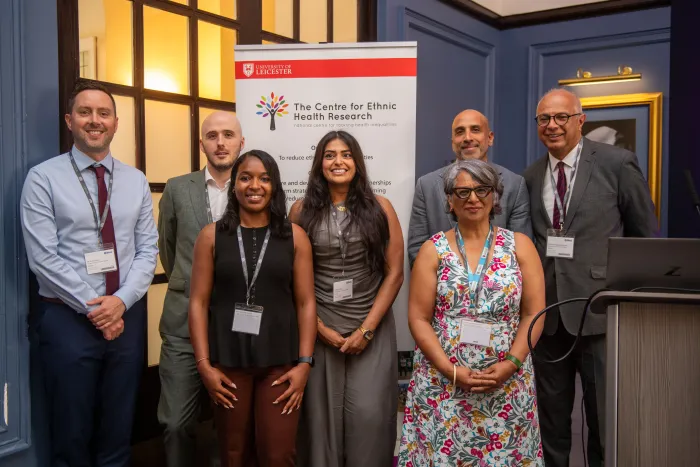
Developed by the Centre for Ethnic Health Research in collaboration with the Medical Research Council, the Co-Trust Toolkit provides researchers with practical guidance to better understand and address barriers to trust among ethnic minority populations.
Building trust in medical research with ethnic minority communities is vital to address health inequalities and ensure new drugs and treatments are safe and effective for everyone.
The toolkit was developed through a programme of research prompted by renewed public interest in the Coventry “chapatti study”, a historical research trial from the 1960s. The Coventry “chapatti study” provided an opportunity to explore trust and mistrust in medical research and to identify practical ways of strengthening relationships between researchers and the communities they serve.
The insights gained through this research informed the development of the Co-Trust Toolkit, which is designed to support multiple stakeholders in becoming more trustworthy in their approaches to medical research and promotes inclusive, transparent and meaningful practices that encourage greater participation among people from ethnic minority backgrounds.
The resource builds on a multi-year project that explored trust within ethnic minority communities, developing a deeper understanding of what trust means, why mistrust exists and how trust can be strengthened through practical co-produced actions that promote trustworthiness as a shared responsibility across the research landscape.
Showcased at a dedicated event at BMA House in London on Wednesday, July 8, the Co-Trust Toolkit is supported by the NIHR ARC East Midlands.
During the launch event, the Editor-in-Chief of The British Medical Journal (BMJ), Professor Kamran Abbasi, highlighted the importance of trust in medical research and chaired the panel discussion on providing accountability without jeopardising rebuilt trust.
He said: “Trust underpins every stage of medical research, from participation to the adoption of new treatments.
“Strengthening that trust requires openness, a willingness to listen and a commitment to continually improving how research is designed and delivered. The Co-Trust Toolkit is an important contribution to that ongoing conversation.”
Professor Sir Nishan Canagarajah, President & Vice-Chancellor of the University of Leicester, opened the event. He commented: “The University of Leicester has long championed research that makes a tangible difference to people's lives.
“The Co-Trust Toolkit reflects the ambition and expertise of our researchers, as well as the invaluable contributions of community partners who have helped shape it. Together, they have created a resource that has the potential to influence research practices well beyond Leicester.”
Professor Kamlesh Khunti, Co-Director of the NIHR ARC East Midlands and Professor of Primary Care, Diabetes and Vascular Medicine at the University of Leicester, said: “The Co-Trust Toolkit is a practical and timely resource that can help build trust, improve inclusion of ethnic minority communities in research, and address longstanding inequalities in who benefits from research. Better representation leads to better evidence, better care and better health outcomes.”
Dr Riya Patel, Co-Principal Investigator of the Co-Trust Toolkit and Research Fellow at the Centre for Ethnic Health Research, noted: “We are delighted to launch our Co-Trust Toolkit.
“Every recommendation within the toolkit has been shaped by listening to communities, learning from their experiences and working together to identify what trustworthy research looks like in practice.”
She added: “It was incredibly encouraging to see so many researchers, community partners and stakeholders come together at our launch with a shared willingness to reflect on how we conduct research and leave with a genuine commitment to taking meaningful action on a challenge that has persisted for many decades.”
Addressing mistrust in medical research has remained a longstanding challenge. Building trust starts with becoming more trustworthy. The Co-Trust Toolkit lays out a roadmap for all those involved with research to embed transparency, accountability and genuine partnership across the research lifecycle, helping to create a more inclusive, equitable and trustworthy research system.
The toolkit will be available on the website soon. The website will also contain resources that further support the implementation and uptake of the toolkit.